
The Ontology Already Exists: How to Find It Before You Build One
Someone has probably already modeled your domain. A field guide to the world's ontology registries — and how to reuse and enhance the right model fast.

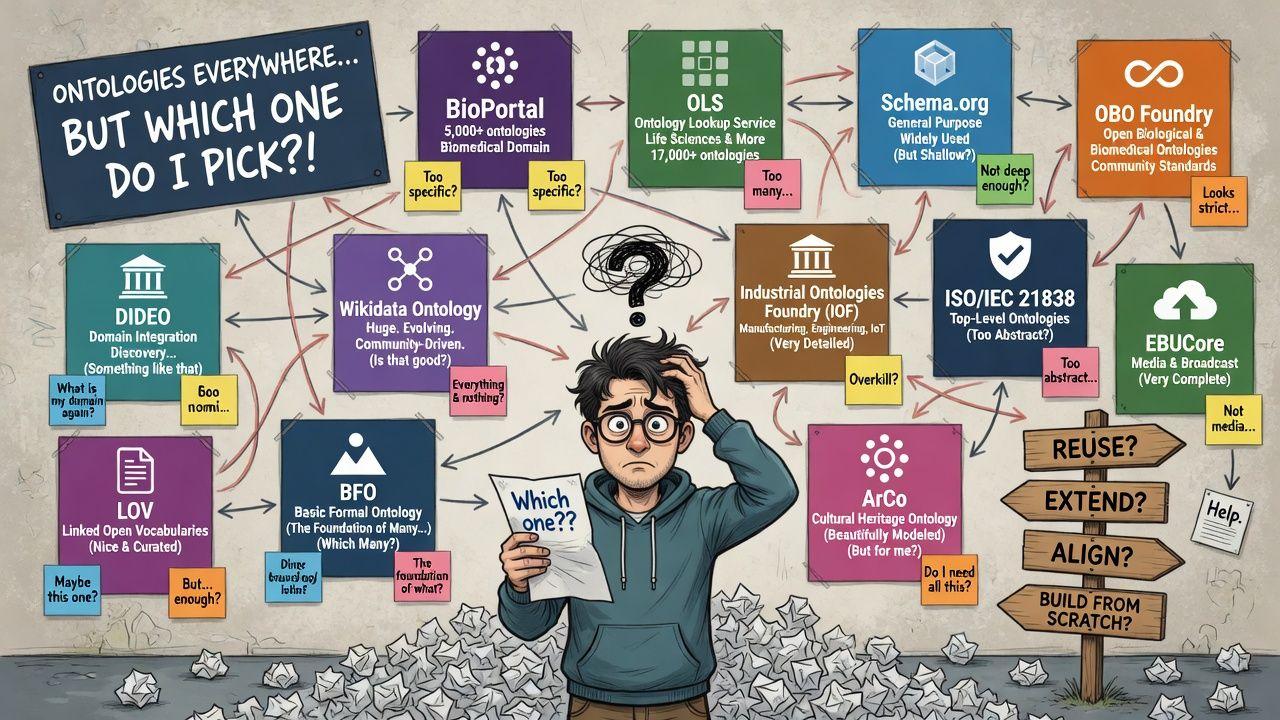
The Problem
When we wrote about building an ontology, step two of the method was three words that sound simple and aren’t: consider reusing what exists.
Here’s why it’s hard. The world has already been modeled — extensively, obsessively, by tens of thousands of people over three decades. Someone has almost certainly mapped your domain, or something close enough to save you months. The catch is that their work is scattered across dozens of registries, buried in academic papers, published under acronyms you’ve never heard of, in formats you have to convert. There is no single front door. There is no Google for “the concept of a customer, done right.”
So teams do the expensive thing. They start from a blank page and reinvent a model that already exists in a better, battle-tested form somewhere on the internet. They burn weeks rebuilding the wheel — and the wheel they build is rounder in their head than it is in reality, because a handful of engineers over a sprint cannot out-model a community that has been refining the same domain since 2005.
You don’t want to reinvent the wheel. But you also don’t want a mediocre, homegrown model. You want the best possible ontology for your system, and you want it fast. Those two goals only reconcile if you can find what already exists.
What We Learned
The world’s ontologies aren’t missing. They’re fragmented. Once you know where to look, the map is remarkably rich.
At the top sit the upper (foundational) ontologies — the abstract scaffolding that everything else hangs from. Basic Formal Ontology (BFO) is the realist backbone under the entire biomedical world. DOLCE leans linguistic and cognitive. SUMO is broad and general-purpose. Pick one as your spine and you inherit decades of careful thinking about what an “object,” an “event,” or a “process” even is.
Below that are the cross-industry vocabularies you can drop into almost anything: schema.org for web entities, Dublin Core for resource metadata, SKOS for taxonomies and controlled vocabularies, FOAF for people and organizations, PROV-O for data lineage, QUDT for units and measurement. These are the standard bolts and brackets of knowledge modeling.
Then come the domain ontologies, and this is where the depth is staggering:
| Domain | Established models you can reuse |
|---|---|
| Biomedicine & health | Gene Ontology (GO), SNOMED CT, UMLS, MeSH, ICD, LOINC, RxNorm, ChEBI, Uberon, Mondo, HPO |
| Finance | FIBO (Financial Industry Business Ontology) |
| Retail & supply chain | GS1 Web Vocabulary, GoodRelations |
| Geospatial & sensors | GeoNames, GeoSPARQL, SOSA/SSN |
| Agriculture & food | AGROVOC, FoodOn |
| Library & publishing | BIBFRAME, FRBR, Dublin Core |
And they live in a handful of registries that are the closest thing to a card catalog of the modeled world:
| Registry | What it holds |
|---|---|
| BioPortal (NCBO) | 800+ ontologies, ~10 million terms — the largest biomedical repository |
| OBO Foundry | 100+ life-science ontologies built on shared principles and a common upper ontology, engineered not to overlap |
| EBI Ontology Lookup Service (OLS) | ~266 ontologies and 8.7 million classes across the life sciences |
| Linked Open Vocabularies (LOV) | ~600 general-purpose semantic-web vocabularies for Linked Data |
| Wikidata | A crowd-sourced knowledge graph that increasingly absorbs and links formal ontologies |
| OntoPortal Alliance | AgroPortal, EcoPortal, MatPortal and more — the same platform, cloned across domains |
That’s the real lesson: the raw material is out there, it’s high quality, and it’s free. The scarce skill isn’t building — it’s finding, judging, and adapting. And in the age of modern LLMs, the move is no longer just to adopt an existing ontology wholesale. It’s to take the best available model and enhance it — extend it to your specifics, fill its gaps, and reconcile it with your data — in a fraction of the time it took to build the original.
What You Can Do About It
Reuse is a process, not a lucky search. Here’s the one we run:
- Name the domain precisely. “We model loans” is too vague to match. “We model residential mortgage servicing events and their regulatory obligations” tells you to go straight to FIBO. Precision is what turns a registry search from noise into a hit.
- Search the right registries first. Biomedical? OBO Foundry and BioPortal. General web or Linked Data? LOV and schema.org. Finance? FIBO. Don’t crawl the open internet — go to the card catalogs.
- Judge fit on more than coverage. A good reuse candidate scores well on five things: does it cover your concepts, at the right granularity, is it actively maintained, does it have a real community behind it, and is its license compatible with your use? A dead ontology with perfect coverage is a liability.
- Reuse the term, not the whole world. You rarely import an entire ontology. The discipline here is to pull in exactly the classes you need and their necessary context — the community even has a standard for it (MIREOT) — so you inherit the good modeling without dragging in ten thousand irrelevant terms.
- Enhance, don’t just adopt. This is the modern part. Once you’ve anchored to an existing model, use LLMs to extend it into your domain’s specifics, propose the classes and relationships it’s missing, and map it onto your actual data. You get the rigor of a community-built ontology and the fit of a custom one.
The failure mode to avoid: treating this as all-or-nothing. You are not choosing between “adopt SNOMED CT unchanged” and “build from scratch.” The right answer is almost always anchor to the best existing model, then enhance it to fit.
Why It Matters
When you reuse well, you compress months into days and end up with a better model than you could have built alone.
You inherit thousands of hours of domain expertise for free. You stay interoperable with the rest of the world — your data speaks the same language as everyone else’s in your field, which matters the day you need to integrate, sell, or get acquired. And your AI reasons over a model that’s already been stress-tested by a whole community, instead of one your team invented under deadline.
This is exactly the work we’ve taken on. We pulled the world’s public ontologies into one place you can actually search — the registries, the upper ontologies, the domain models, condensed and cross-referenced. So when a client brings us a new domain, we don’t start from a blank page. Our agents mine that catalog, surface the models that fit, and adapt and enhance the best of them for the problem at hand.
That’s the whole game: the best possible ontology, in the least possible time, because most of the world has already been modeled — and we know where it lives.
At Periscoped, we help companies stand on the shoulders of thirty years of knowledge modeling — finding the right existing ontology, enhancing it with modern AI, and shipping a domain model that’s both world-class and yours.
Enjoyed this? Explore more on ontologyaiarchitecturedata engineering or get in touch.